
What mattered to you ahead of the Autumn Budget
Ahead of the Autumn Budget, we asked which financial pressures were being felt most keenly and which potential announcements could have the greatest impact on financial plans. Taxation, everyday costs and uncertainty all featured, alongside a range of views on possible reforms. Here, we look at the results of our survey, offering a snapshot of the issues on respondents’ minds as they awaited the Chancellor’s announcements on Wednesday 28th October.
Tax and everyday costs lead financial concerns
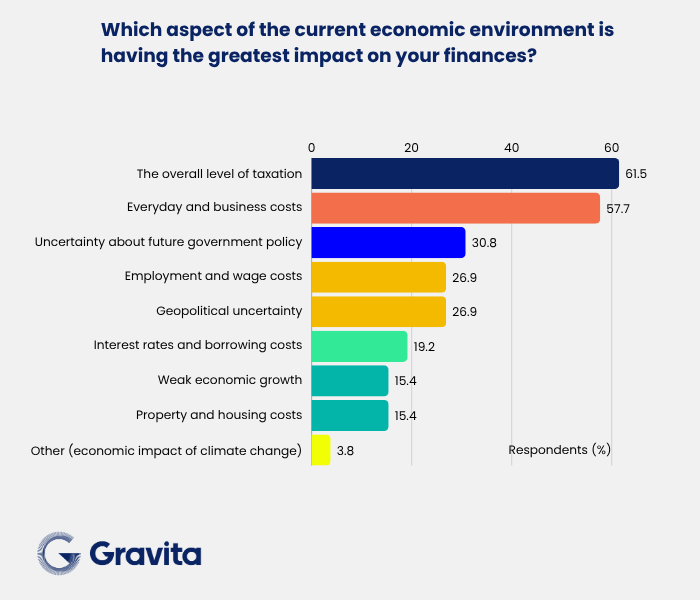
We asked which aspects of the current economic environment were having the greatest impact on respondents’ finances, with the option to select up to three. The overall level of taxation led at 61.5%, closely followed by everyday and business costs at 57.7%. These were the only two issues selected by more than half of respondents, highlighting the pressure of tax and day-to-day spending on personal and business finances.
Uncertainty about future government policy came third at 30.8%. Alongside managing existing costs, respondents are also considering what might change next. Uncertainty can make it harder to commit to investment, spending or longer-term financial plans. For those seeking clarity from the Budget, the timing and detail of any changes may be as important as the announcements themselves.
Employment and wage costs and geopolitical uncertainty followed, each selected by 26.9%. These reflect different challenges, from the practical costs of employing people to international developments that businesses and individuals have little control over.
The findings suggest that the Budget will be assessed against immediate financial pressures as well as its longer-term ambitions. For respondents, the key questions are what it means for their costs and whether it provides greater certainty for the decisions ahead.
Personal allowance changes lead the Budget watch list
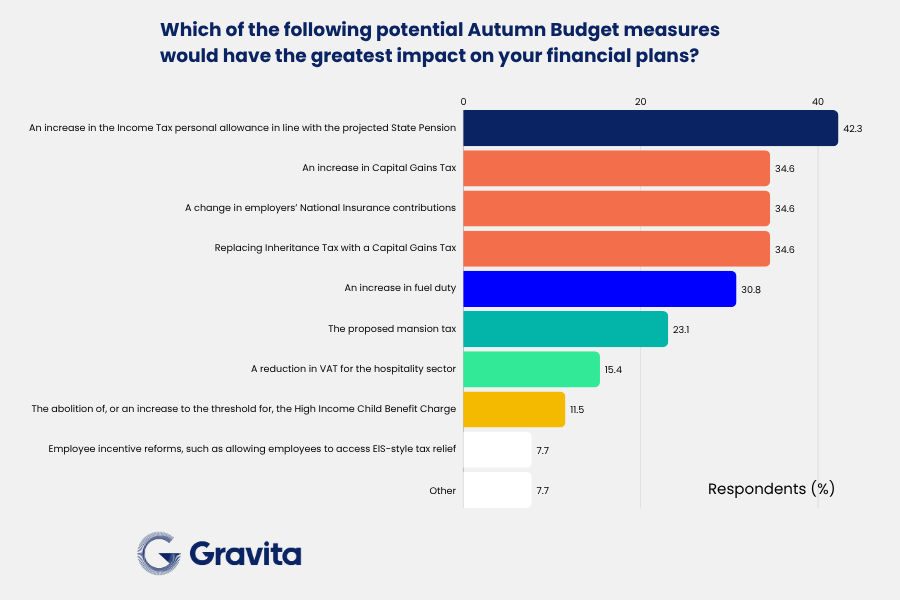
We asked which potential Autumn Budget measures would have the greatest impact on respondents’ financial plans, allowing up to three selections. An increase in the Income Tax personal allowance in line with the projected State Pension came first at 42.3%. Its position highlights the importance of the relationship between tax allowances and income when people consider their finances.
Three measures shared second place at 34.6% each: an increase in Capital Gains Tax, a change in employers’ National Insurance contributions and replacing Inheritance Tax with a Capital Gains Tax. These span different financial decisions, from the cost of employing people to selling assets and passing on wealth.
The results measure potential impact rather than support for any particular policy. Nevertheless, the three-way tie shows that respondents are watching several areas of taxation closely, with implications for both personal and business planning.
An increase in fuel duty followed at 30.8%, bringing everyday expenditure into the picture alongside those longer-term considerations. The proposed mansion tax was selected by 23.1%.
Overall, no single measure dominated respondents’ choices. The findings suggest that attention will be spread across the Budget, with changes to income, employment and asset taxation all relevant to the financial decisions respondents face.
Individual views reveal different priorities for tax reform
We also asked whether respondents wanted to tell us anything else ahead of the Autumn Budget. The optional comments offered a more personal perspective, with concerns about stability sitting alongside suggestions for reform.
One respondent questioned the economic effect of further tax increases: “Higher tax rates will only reduce overall tax revenue and dampen activity.”
Another highlighted uncertainty around retirement planning: “The worry of constant retrospective changes on pensions.”
There was also an appetite for changing how taxes are structured: “Increase in both bands at which tax is paid and a small higher rate increase. I liked the ideas being floated of an annual tax on property values replacing Council Tax and Stamp Duty”
These individual observations suggest different priorities rather than a single shared position. Among those who commented, the discussion extended beyond tax rates to questions about predictability, economic activity and how the tax system could work differently.
Talk to our tax team
If the Budget has raised questions about your finances or business plans, our tax team is here to help. We can explain what the announcements mean for your circumstances and discuss the practical steps to consider next. Get in touch with your usual Gravita contact to arrange a conversation today.
Similar Insights

Personal tax planning before and after selling your business

Andy Burnham announces the abolition of the triple lock on pensions

Autumn Budget 2026: What could it mean for VAT and business growth?
Sign up to Gravita's latest updates and newsletters
Stay up-to-date with our event invites, latest news and updates, straight from Gravita's experts.